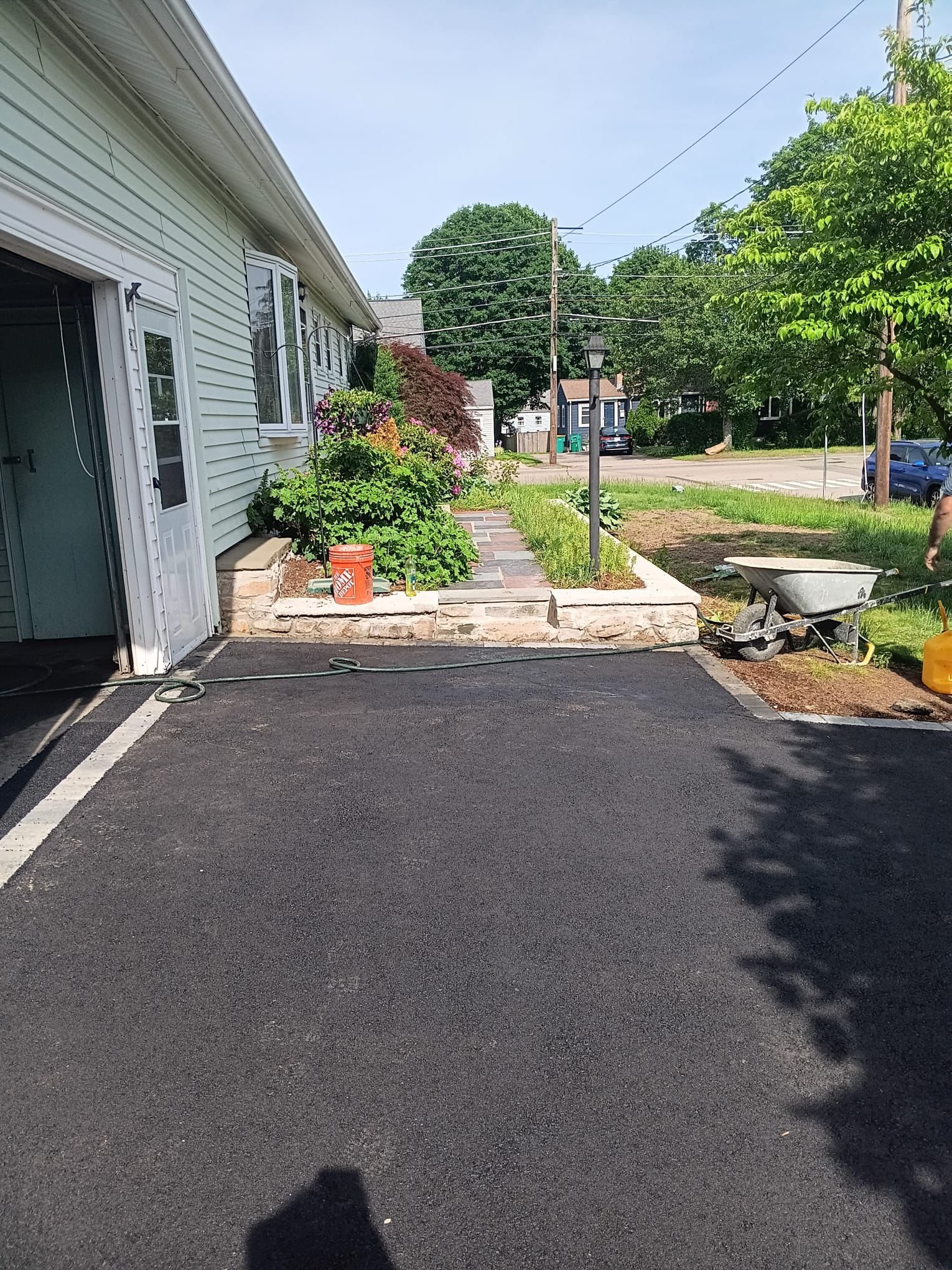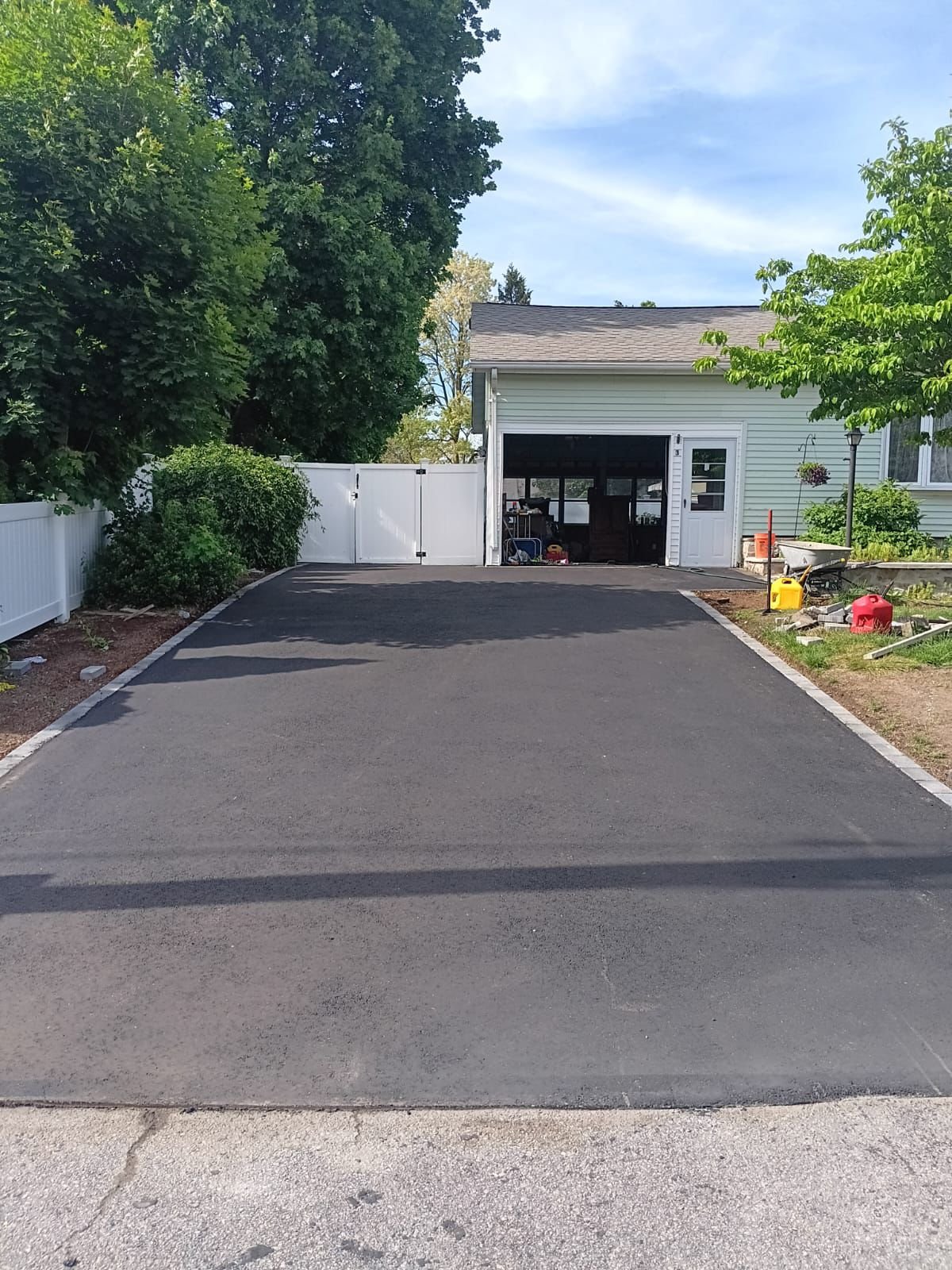
Cracks are among the first visible signs that an asphalt driveway is beginning to deteriorate. Some cracks can be sealed as part of routine maintenance, while others indicate base failure, poor drainage or extensive pavement fatigue.
Choosing the wrong solution can waste money. Applying sealcoat over an actively moving crack will not restore structural support, while replacing an entire driveway for a few stable cracks may be unnecessary.
Dedham driveways must withstand vehicle traffic, rain, snow, ice, de-icing materials and repeated freeze-thaw cycles. Once water enters a crack, it can reach the base below the asphalt. Freezing, erosion and continued traffic can then enlarge the crack and contribute to potholes or settlement.
The decision to seal, patch, resurface or replace should be based on the crack pattern, pavement condition, drainage and stability of the underlying base.
Quick answer: Should asphalt cracks be sealed, repaired or replaced?
Crack sealing may be appropriate when:
- Cracks are limited and relatively narrow
- The surrounding asphalt remains solid
- There is no major settlement
- The driveway drains properly
- The base appears stable
- Cracking is addressed before winter
Patching or localized repair may be appropriate when:
- Damage is limited to one area
- A pothole has formed
- A section has sunk or broken
- The failed asphalt can be removed
- The underlying base can be repaired
Resurfacing may be appropriate when:
- The surface is worn or moderately cracked
- The base remains stable
- Drainage is generally satisfactory
- Widespread structural failure is not present
- A new asphalt layer can bond correctly
Replacement may be better when:
- Alligator cracking covers large areas
- The driveway has widespread settlement
- The base is unstable
- Potholes repeatedly return
- Drainage problems affect several sections
- Multiple repairs have failed
- The asphalt is breaking apart throughout its depth
A contractor should inspect the complete pavement system—not just the visible surface.
Why asphalt driveways crack
Asphalt consists of aggregate held together by an asphalt binder. Over time, exposure to weather, oxygen, sunlight, water and vehicle loads changes its condition.
Aging and oxidation
As asphalt ages, the binder gradually becomes less flexible. The surface may fade, dry and become more vulnerable to cracking.
Water infiltration
Open cracks allow water to enter the pavement and base. Water can weaken supporting materials, wash away fine particles and contribute to settlement.
Freeze-thaw cycles
Water beneath or within cracked pavement can freeze and expand. When it thaws, the pavement may no longer be uniformly supported.
Poor drainage
Standing water, runoff and saturated soil can weaken the base beneath the driveway. Low spots and improper grading also allow water to remain on the surface.
Weak or poorly compacted base
A driveway depends on properly prepared and compacted supporting layers. If the base shifts or settles, the asphalt above may crack.
Tree roots
Roots can lift, displace or crack pavement. Removing a root without considering the tree and base conditions may create other problems.
Heavy vehicles
Repeated loads from large trucks, dumpsters or construction equipment can damage a driveway not designed for that level of traffic.
Utility trenches
Previously excavated areas may settle differently from undisturbed soil, causing cracks along trench lines.
Poor installation
Inadequate compaction, unsuitable asphalt thickness, poor joints or paving over wet materials can shorten pavement life.
Common types of asphalt driveway cracks
The crack pattern can provide clues about the cause.
Longitudinal cracks
These run generally in the same direction as the driveway. Possible causes include:
- Joint separation
- Base movement
- Frost movement
- Poor compaction
- Edge stress
A limited longitudinal crack may be sealable if the surrounding pavement remains stable.
Transverse cracks
These run across the driveway and can develop from temperature-related contraction, aging or movement in the layers below.
Sealing can help limit water entry when the cracks are stable and not severely displaced.
Edge cracks
Edge cracking develops near the sides of the driveway.
Common causes include:
- Insufficient edge support
- Water erosion
- Vehicle loads near the edge
- Vegetation
- Poor drainage
- Narrow pavement width
The edge may need rebuilding and additional support rather than crack filling alone.
Block cracking
Block cracking divides the surface into relatively large rectangular sections. It is often associated with aging and shrinkage of the asphalt.
The appropriate solution depends on the severity and condition of the base.
Alligator cracking
Alligator or fatigue cracking creates a network of small, interconnected cracks resembling reptile skin.
It often indicates failure beneath the asphalt, such as:
- Weak base
- Repeated loading
- Poor drainage
- Inadequate pavement structure
Pouring crack sealer over alligator cracking generally does not address the failed support below. The damaged area may require removal and full-depth repair.
Reflection cracking
Cracks from an older pavement layer, joint or repaired area can eventually appear through a newer overlay.
Settlement cracks
Cracks accompanied by sinking or uneven areas usually indicate movement below the surface.
Crack sealing versus sealcoating
These are different maintenance services.
Crack sealing
Crack sealing places a flexible material into or over prepared cracks to reduce water and debris entry.
The process may include:
- Cleaning the crack
- Removing vegetation and loose debris
- Preparing or routing the crack where appropriate
- Applying a suitable crack-sealing material
- Allowing the material to cure
The Asphalt Institute identifies crack sealing as an important pavement-maintenance method when performed with suitable materials and correct preparation.
Sealcoating
Sealcoating applies a thin protective coating across the asphalt surface.
It may help:
- Renew an aged, dry surface
- Fill very small surface voids
- Reduce weather exposure
- Improve uniformity of appearance
Sealcoat does not provide structural strength and will not permanently repair wide, moving or alligator cracks.
Cracks should be repaired appropriately before sealcoating.
When crack sealing is the right solution
Crack sealing may be useful when:
- Cracks are isolated
- Pavement surrounding the crack is sound
- There is limited vertical displacement
- Water has not severely damaged the base
- Cracks can be cleaned and prepared
- The driveway still drains properly
Sealing cracks early can slow water entry and help extend the useful life of the pavement.
When localized asphalt repair is needed
Localized repair is appropriate when damage extends below the surface but remains limited to a specific area.
Pothole repair
A durable pothole repair may require:
- Cutting back to sound pavement
- Removing failed asphalt
- Repairing the base
- Applying appropriate bonding material
- Installing and compacting new asphalt
- Sealing the edges
Placing loose material into a wet pothole without repairing the base is usually a temporary measure.
Full-depth patching
A full-depth patch removes both failed asphalt and unstable base materials. It is often used for:
- Alligator cracking
- Deep potholes
- Settlement
- Utility-cut failure
- Localized base damage
Edge repair
Damaged edges may require rebuilding the base and asphalt, then improving shoulder support and drainage.
When asphalt resurfacing may work
Resurfacing, also called an overlay, installs a new asphalt layer over the existing driveway.
It may be considered when:
- The existing surface is worn
- Cracks are repairable
- The base remains stable
- Major drainage problems are absent
- Elevations allow an additional layer
- Transitions at garages, sidewalks and roads can be maintained
Before resurfacing, failed areas should be repaired and the existing surface properly prepared.
Resurfacing is unlikely to perform well when the old driveway has widespread base failure. Cracks and movement may eventually reflect through the new layer.
When driveway replacement is the better investment
Complete replacement may be appropriate when:
Cracking is widespread
Large areas of alligator cracking suggest that the driveway structure is failing rather than experiencing isolated surface wear.
The base has failed
If the supporting material is saturated, poorly compacted or extensively settled, it should be removed and reconstructed.
Drainage is fundamentally wrong
Replacement provides an opportunity to correct elevations, slopes and water flow.
Several areas have sunk
Widespread settlement is difficult to correct with surface patches alone.
The driveway has been repeatedly patched
A patchwork surface with recurring problems may be more expensive to maintain than replace.
Resurfacing would create elevation problems
An overlay can raise the driveway surface and create issues at garage floors, steps, sidewalks, drainage structures or the public road.
Comparison: seal, repair, resurface or replace
| Condition | Likely option |
| Small isolated cracks | Crack sealing |
| Dry, aged surface with very minor cracking | Crack repair and possible sealcoating |
| One pothole or sunken area | Localized/full-depth patch |
| Moderate wear with stable base | Resurfacing |
| Extensive alligator cracking | Full-depth repair or replacement |
| Widespread settlement | Replacement |
| Major drainage or grading failure | Base correction and possible replacement |
| Repeated repair failure | Replacement evaluation |
The final recommendation requires an on-site inspection.
Why drainage affects asphalt driveway repairs
Even well-installed asphalt can fail when water repeatedly collects on or beneath it.
Inspect:
- Low spots
- Water flowing from downspouts
- Garage runoff
- Soil erosion along edges
- Cracked drainage channels
- Water coming from neighboring grades
- Saturated shoulders
- Puddles near repaired areas
- Snowmelt pathways
Potential improvements include:
- Adjusting driveway slope
- Installing channel drains
- Redirecting downspouts
- Rebuilding failed edges
- Improving the base
- Correcting adjoining walkways or landscaping
- Installing appropriate subsurface drainage
Drainage corrections should be coordinated with the paving work.
Can driveway cracks be repaired during winter?
Cold and wet conditions affect asphalt-repair materials, adhesion and compaction.
Temporary repairs may be needed for an immediate hazard, but permanent crack sealing and hot-mix repairs are generally best completed under suitable product and weather conditions.
Cracks identified before winter should be inspected early enough to allow proper maintenance.
How much does asphalt driveway repair cost?
The cost depends on:
- Driveway size
- Number and width of cracks
- Type of cracking
- Pothole depth
- Base condition
- Accessibility
- Drainage improvements
- Asphalt removal
- Disposal requirements
- Resurfacing thickness
- Edge and transition work
- Complete replacement requirements
A few prepared cracks will cost less than full-depth patching, resurfacing or reconstructing the entire driveway.
The lowest initial price is not always the lowest long-term cost. A surface-only repair over a failed base may need to be repeated.
Maintaining an asphalt driveway
Homeowners can help extend driveway life by:
- Repairing open cracks promptly
- Keeping the surface clean
- Preventing standing water
- Redirecting downspouts
- Avoiding fuel and oil spills
- Limiting heavy construction vehicles
- Protecting unsupported edges
- Removing vegetation from cracks
- Using appropriate snow-removal equipment
- Avoiding aggressive metal blades
- Inspecting after winter
- Applying maintenance products only when needed
The Asphalt Institute notes that a newly constructed driveway generally should not require immediate sealing; timing depends on climate, surface condition and workmanship.
Asphalt driveway repair in Dedham
iFix Masonry and Home Improvements provides professional driveway repair in Dedham and surrounding Greater Boston communities.
Our services include:
- Asphalt crack sealing
- Pothole repair
- Full-depth patching
- Driveway resurfacing
- Asphalt driveway replacement
- Base reconstruction
- Edge repair
- Drainage correction
- New driveway installation
- Driveway grading
We serve Dedham, Canton, West Roxbury, Boston, Brookline, Cambridge, Newton, Waltham and nearby areas.
Request an asphalt driveway assessment
If your driveway is cracked, sinking or collecting water, arrange an inspection to determine whether sealing, patching, resurfacing or replacement provides the best value.
Call: (617) 251-3916
Email: info@ifixmasonry.com
Address: 437 Turnpike St, Canton, MA 02021
Contact iFix Masonry for asphalt driveway crack repair in Dedham, MA.