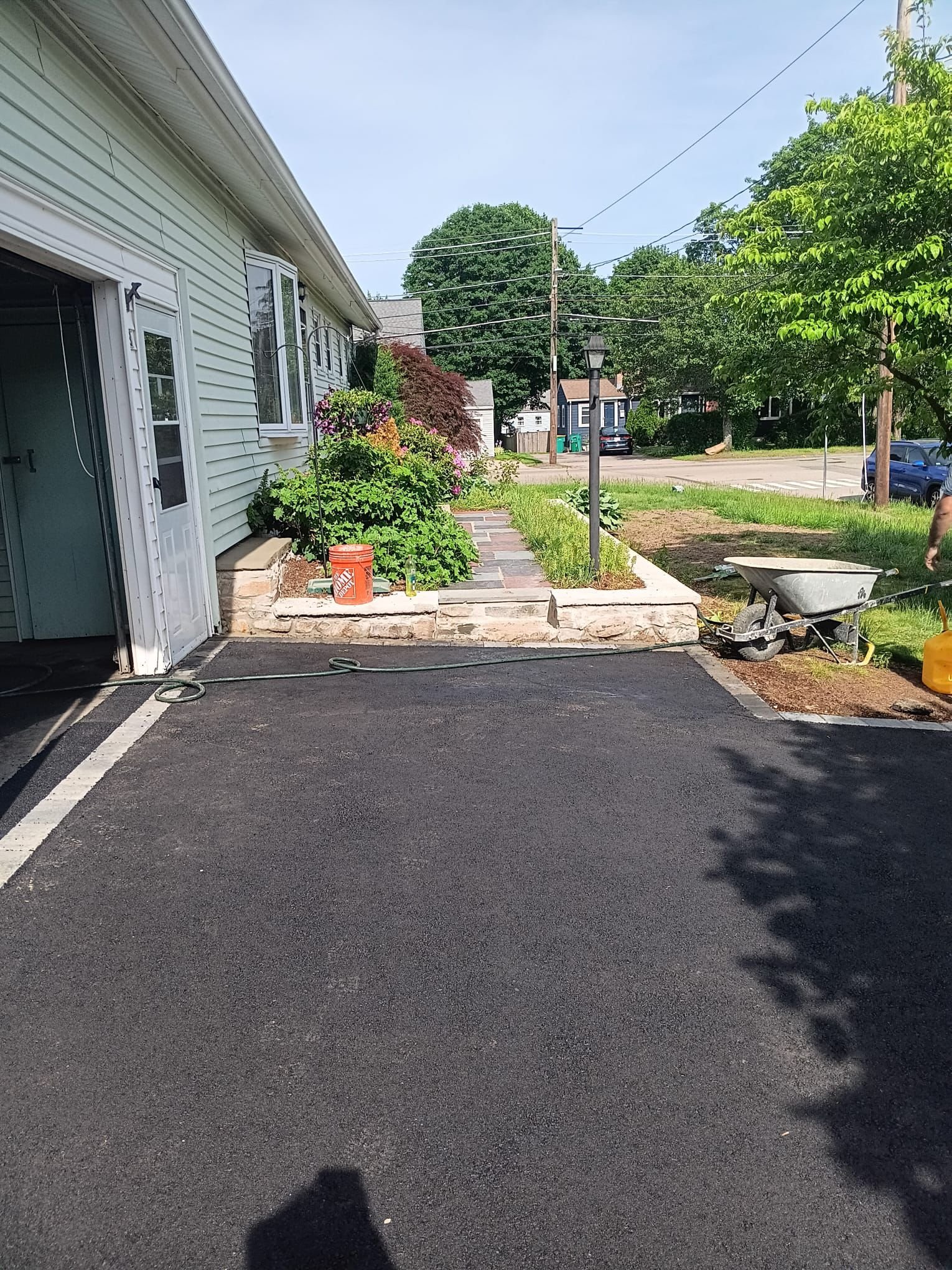
A retaining wall must resist the weight of the soil behind it. When water accumulates in that soil, the wall may also be forced to resist additional hydrostatic pressure.
That added pressure can contribute to cracking, leaning, bulging, sliding and eventual failure.
Newton properties often contain sloped yards, terraced landscapes, driveways and older stone walls. These features can direct rain, irrigation and snowmelt toward a retaining wall. If water cannot escape through suitable drainage, pressure can build behind the structure or erode its base.
A durable retaining wall therefore needs more than attractive stone, brick, block or concrete. Its drainage, backfill, foundation and surface grading must work together as a complete system.
Quick answer: Why does a retaining wall need drainage?
Retaining wall drainage helps:
- Prevent water pressure from building behind the wall
- Move groundwater toward a safe outlet
- Reduce soil saturation
- Limit freeze-thaw movement
- Protect the wall base
- Reduce erosion and soil loss
- Prevent staining and efflorescence
- Extend the wall’s service life
A typical system may include free-draining aggregate, perforated drainage pipe, filter fabric, outlets, weep holes and appropriate surface grading.
The exact design depends on the wall type, height, soil, slope, groundwater and surrounding property.
How water pressure affects a retaining wall
Dry soil places lateral pressure against a retaining wall. When the same soil becomes saturated, the water adds weight and pressure.
Water can also:
- Reduce the soil’s strength
- Wash fine particles away
- Erode the wall base
- Cause settlement
- Freeze and expand
- Move backfill through wall joints
- Create sinkholes behind the wall
- Increase loads during heavy storms
Federal Highway Administration guidance recommends avoiding hydrostatic pressure in retaining-wall design through appropriate drainage.
Where water behind a retaining wall comes from
Rainfall
Rain enters the soil above and behind the wall. Heavy or prolonged storms can saturate backfill that normally drains adequately.
Snowmelt
Snow stored above or beside the wall may release a large amount of water during a short warming period.
Irrigation
Sprinklers and landscape watering can repeatedly saturate the soil, even during otherwise dry weather.
Roof runoff
A downspout discharging uphill from a retaining wall can concentrate roof water behind it.
Driveways and patios
Impermeable surfaces can direct runoff toward the wall instead of allowing it to disperse.
Groundwater
Some walls intersect natural groundwater movement. Surface corrections alone may not resolve this condition.
Neighboring properties
Runoff can cross property boundaries or move downslope from an adjoining lot.
Broken pipes
Irrigation, drainage or water-supply leaks can saturate a localized area behind the wall.
Essential components of retaining wall drainage
No single component works for every project. A properly designed system may combine several elements.
Free-draining backfill
Crushed stone or other suitable free-draining material is commonly placed directly behind a wall.
It creates a zone through which water can move more easily than it would through compacted clay or organic soil.
The drainage aggregate should:
- Be suitable for the wall system
- Extend to the intended height and width
- Remain free of excessive soil contamination
- Connect to a functioning drain
- Be protected from migration of surrounding soil where appropriate
Using decorative surface gravel alone does not create a complete drainage system.
Perforated drainage pipe
A perforated pipe may be installed near the base of the wall to collect water from the drainage aggregate.
The pipe should:
- Have a suitable slope
- Be surrounded by appropriate drainage stone
- Discharge to an approved location
- Remain accessible for maintenance where practical
- Be protected from soil intrusion
- Avoid creating erosion at the outlet
A pipe that has no functioning outlet can fill with water and provide little benefit.
Filter fabric or geotextile
Filter fabric may separate drainage aggregate from surrounding soil.
Its purpose is to allow water movement while reducing the migration of fine soil into the stone and drainpipe.
Incorrect fabric selection or installation can restrict drainage, so it should be chosen for the site and soil conditions.
Weep holes
Weep holes are openings through certain masonry or concrete walls that allow water to escape.
They may be useful when:
- They are part of the wall’s drainage design
- Water can reach them
- Their spacing and location are appropriate
- Outlets remain open
Drilling random holes into an existing retaining wall is not a complete drainage solution and could damage the wall, reinforcement or concealed services.
Surface grading
The finished ground above the wall should direct surface water toward a safe drainage route rather than allowing it to collect behind the structure.
Possible features include:
- Positive grading
- Shallow swales
- Surface inlets
- Channel drains
- Controlled downspout connections
- Appropriate landscaping
The wall’s below-grade drainage cannot be expected to handle unlimited concentrated runoff from above.
Drainage outlets
Collected water must discharge somewhere safe and legal.
The outlet should not:
- Erode the wall base
- Flood neighboring property
- Create ice on walkways
- Discharge against the foundation
- Undermine a driveway
- Return water behind the wall
Municipal rules and site conditions should be checked before installing an outlet.
Drainage for different retaining-wall types
Segmental block retaining walls
Segmental walls use interlocking manufactured units and commonly include:
- Leveling base
- Drainage aggregate
- Perforated pipe
- Reinforced soil where required
- Filter fabric in suitable locations
The joints between segmental blocks are not normally mortared shut because the system is intended to manage drainage and movement.
Natural stone walls
Dry-laid stone walls can be relatively free-draining because of their open joints. However, they still need:
- Stable base preparation
- Suitable backfill
- Protection against soil washing through
- Safe surface runoff
- Drainage at the base where needed
Mortared stone walls require more deliberate drainage because water cannot escape as freely through the face.
Brick retaining walls
Brick walls require careful attention to:
- Mortar-joint durability
- Wall thickness
- Reinforcement
- Waterproofing
- Flashing or caps
- Drainage behind the wall
Brick should not be expected to act as the primary drainage path.
Poured-concrete walls
Concrete walls may use:
- Exterior waterproofing
- Drainage boards
- Free-draining backfill
- Perforated footing drains
- Weep holes in some designs
- Reinforcement appropriate to the loads
Cracks in concrete may allow water through but should not be treated as intentional drainage.
Timber retaining walls
Timber walls also require drainage and base preparation. Trapped moisture can accelerate wood deterioration and connection failure.
Signs of poor retaining wall drainage
Leaning or rotating
A wall leaning outward may be responding to soil pressure, water pressure, inadequate design or base movement.
Horizontal cracking
Horizontal cracks may indicate bending or excessive lateral pressure.
Stair-step cracks
Brick and block walls may crack along mortar joints as movement develops.
Bulging
A localized bulge suggests that part of the wall is moving or losing support.
Water flowing through cracks
Water escaping from random cracks rather than intended outlets indicates uncontrolled water movement.
Persistent dampness
Dark patches, algae, moss or efflorescence may indicate that the wall remains wet.
Clogged weep holes
Sediment, roots, mortar or debris can block intended drainage openings.
Soil sinking behind the wall
A depression or hole can indicate that fine soil is washing into the drainage system or through the wall.
Erosion at the base
Water discharging without proper control may undermine the wall.
Separation at wall sections
Gaps between adjoining sections can indicate movement or settlement.
Why retaining walls fail during or after winter
Water behind a wall can freeze and expand. Saturated soil may also move as temperatures change.
Winter-related stress can include:
- Frost heave
- Frozen drainage outlets
- Ice buildup
- Snowplow loads
- Road-salt exposure
- Concentrated snow storage
- Rapid snowmelt
- Saturated spring soil
A wall may appear stable during dry weather but move after a wet winter or rapid thaw.
Can drainage repair straighten a leaning wall?
Drainage improvement can reduce future water pressure, but it does not automatically return a displaced wall to its original position.
A leaning wall may require:
- Partial dismantling
- Base reconstruction
- Rebuilding
- Reinforcement
- Anchoring
- Soil correction
- Engineered stabilization
Drainage should be incorporated into the structural repair so the original problem does not return.
Retaining wall drainage repair options
Clean existing outlets
Blocked weep holes and drain outlets may sometimes be cleaned if the rest of the system remains functional.
Repair the outlet
A damaged, buried or eroded outlet may need extension, protection or relocation.
Install surface drainage
Swales, channel drains or catch basins may intercept runoff before it reaches the wall.
Redirect downspouts
Roof water should not discharge directly behind a retaining wall.
Install a new drainage pipe
Some walls may require excavation and installation of a perforated drain surrounded by free-draining aggregate.
Replace contaminated backfill
Soil mixed into the drainage stone can restrict water flow. Rebuilding may require removing and replacing the backfill.
Add waterproofing or drainage membrane
Certain solid walls may benefit from a properly specified waterproofing and drainage layer on the soil side.
Rebuild the wall
If movement or deterioration is extensive, rebuilding may be the only way to restore:
- Base support
- Wall alignment
- Reinforcement
- Backfill
- Drainage
- Surface grading
Can a French drain protect a retaining wall?
A French drain may help intercept groundwater or runoff before it reaches the retained soil.
It may be installed:
- Uphill from the wall
- Behind the wall
- At the base
- Along a property drainage route
Its suitability depends on the source of water, available slope, soil and outlet.
A French drain should not be installed without knowing where the water will discharge.
Should retaining wall cracks be patched?
Cracks should be repaired only after the wall’s stability and drainage have been evaluated.
Patching alone may fail when:
- The wall is moving
- Water pressure remains
- The base has settled
- Reinforcement has corroded
- The crack extends through the wall
- Soil is washing through
A stable cosmetic or mortar crack can sometimes be repaired after the cause has been addressed.
When is engineering needed?
Engineering input may be appropriate when:
- The wall is tall or supports substantial soil
- A building, driveway or slope is close to the top
- The wall is significantly leaning
- Global slope stability is uncertain
- Groundwater is substantial
- Failure could affect people or property
- Reinforcement or anchors are proposed
- Local requirements call for engineered design
Small decorative garden walls and major structural retaining walls should not be treated as the same type of project.
Does retaining wall repair require a permit?
Requirements depend on wall height, location, loading, property conditions and scope.
Newton property owners should check with the local building department before:
- Constructing a new retaining wall
- Increasing wall height
- Rebuilding a structural wall
- Altering drainage
- Working near property boundaries
- Supporting a driveway, building or steep slope
Drainage work must also avoid creating problems for neighboring properties or public areas.
How much does retaining wall drainage repair cost?
Cost factors include:
- Wall length and height
- Wall material
- Access
- Excavation
- Existing wall movement
- Amount of backfill replacement
- Drainpipe length
- Outlet location
- Waterproofing
- Surface-drainage improvements
- Engineering
- Permits
- Partial or complete rebuilding
Cleaning a blocked outlet costs less than excavating and rebuilding a failing structural wall. An inspection is required to determine the actual scope.
Retaining wall and drainage services in Newton
iFix Masonry and Home Improvements provides professional retaining wall services in Newton and drainage solutions throughout Greater Boston.
Our services include:
- Retaining wall inspections
- Leaning wall repair
- Stone and brick wall restoration
- Segmental wall installation
- Concrete retaining walls
- Retaining wall drainage
- French drain installation
- Drainage-pipe replacement
- Grading improvements
- Wall rebuilding
We serve Newton Centre, Waban, Nonantum, Auburndale, Newtonville and nearby communities.
Request a retaining wall inspection
If your retaining wall is leaning, cracking, bulging or holding water, arrange an assessment before patching the visible damage.
Call: (617) 251-3916
Email: info@ifixmasonry.com
Address: 437 Turnpike St, Canton, MA 02021
Contact iFix Masonry for retaining wall drainage and repair in Newton, MA.